Why Does a Belt Change Your Leg Line More Than the Trousers Do?
Quick Answer: Visually, your legs appear to begin at the lowest strong horizontal line on your torso — not at your actual hip joint. A belt creates exactly that kind of line, so its height, width, and contrast do more to set apparent leg length than the cut of the trousers underneath. A high, narrow, low-contrast belt lengthens; a low, wide, high-contrast one shortens.
You can change trousers three times and get the same photograph.
Change where the horizontal line sits and the whole proportion moves.
This is general information, not medical advice.
How does the eye decide where your legs start?
It looks for the break, not the joint.
Nobody can see your hip joint through clothing. What the eye actually does is scan for the strongest horizontal division in the middle of the body and treat everything below it as leg. That division might be a waistband, a hem, a colour change, or a belt — whichever is most visually assertive.
This is why the same trousers can read completely differently depending on what is happening at the waist. The trousers control where the fabric physically sits. The belt controls where the eye thinks the division is, and the eye wins.
Three properties determine how strongly a belt claims that job:
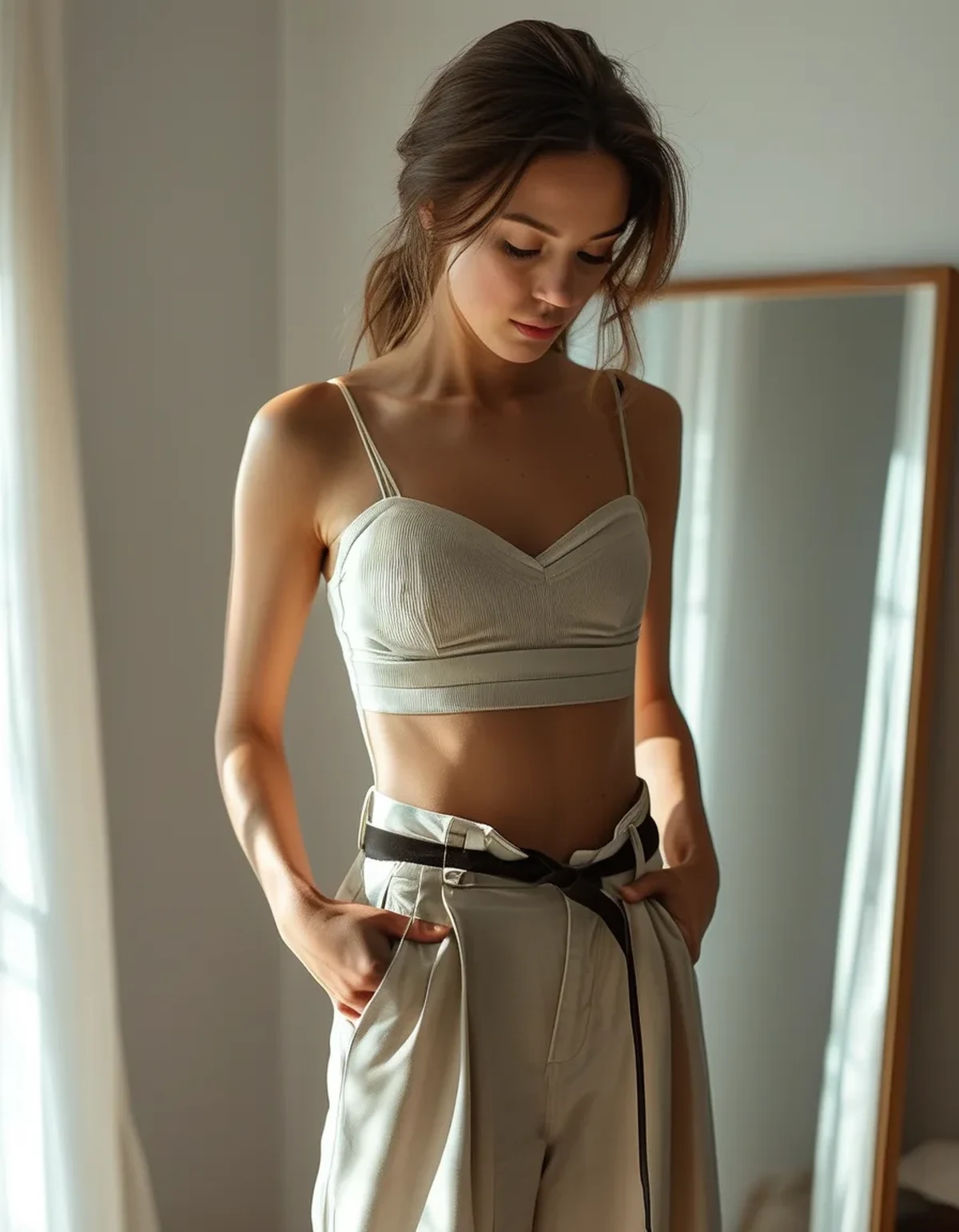
Height. The higher the line, the longer the apparent leg. A belt sitting at the natural waist adds visible leg length compared with one at the hip, even with identical trousers.
Contrast. A belt that contrasts sharply with everything around it becomes the dominant line. A tonal belt that blends recedes, and the eye keeps searching upward for a break — which usually works in your favour.
Width. A wide belt occupies real estate. It is not a line, it is a band, and a band of contrasting colour effectively removes that section from both the torso and the legs.
Does this mean high contrast belts are a mistake?
Not a mistake — a choice with a consequence. A contrasting belt draws the eye to the waist, which is exactly what you want if defining the waist is the priority. It just does not lengthen at the same time.
What combination actually lengthens the leg?
The reliable version is: high, narrow, and tonal with the top.
High means at the natural waist, the narrowest part of the torso, typically a little above the navel — not at the hip bone. Every centimetre the visual break rises is a centimetre added to apparent leg length.
Narrow means a belt that reads as a line rather than a band. Somewhere in the region of two to three centimetres is enough to define without occupying.
Tonal with the top is the counterintuitive one. Most advice says match the belt to the shoes. For leg line, matching the belt to the top half is stronger: the belt disappears into the torso and the trouser colour begins higher, so the leg column starts higher.
Matching the belt to the trousers instead extends the leg column upward, which also works well and is easier to achieve with a black belt and black trousers.
The combination that shortens most reliably is the opposite: a wide, contrasting belt worn low. It creates a strong band at the hip, cuts the torso off well below the waist, and starts the leg column at the lowest possible point.
Where does a belt over an untucked top fit in?
A belt worn over a loose top or a knit works the same way, and the effect is often stronger because it also creates shape where the garment had none. Keep it high — the temptation with a longer top is to belt it at the hip, which is the shortening position.

How belt choice interacts with rise
Belt and rise are not independent decisions. They compound, in both directions.
High rise with a high tonal belt is the strongest lengthening combination available, and it is why the pairing has persisted through decades of changing trends. The waistband is already high; the belt confirms the line rather than competing with it.
High rise with a wide contrasting belt partly wastes the rise. You have raised the physical waistband and then drawn a thick band across it, which the eye reads as a block rather than a starting point.
Mid or low rise with any belt puts the line at or near the hip. There is a limit to what belt choice can rescue here — the belt cannot sit above the waistband it is threaded through. If lengthening is the goal, the rise is the first decision and the belt is the second.
No belt at all with a high rise and a tucked top is often the cleanest lengthening option of all, because there is no horizontal interruption whatsoever — just a colour change at the waist. Belt loops left empty are a legitimate choice.
What about the belt buckle itself?
A large, bright, or highly detailed buckle behaves like a spotlight on the waist. That is useful when you want attention there. For lengthening, a small or covered buckle keeps the line uninterrupted, and a buckle that matches the strap keeps it quietest of all.
Myth vs Fact: belts and proportion
Myth: Your belt should always match your shoes. Fact: That is a coordination convention, not a proportion rule. For leg line, matching the belt to your top or your trousers does more work. Shoe matching is a fine default when nothing else is competing for attention.
Myth: Wide belts define the waist better. Fact: Wide belts define a region; narrow belts define a point. If the aim is a defined waist that also reads high, narrow usually wins. Wide belts can look excellent — they just tend to shorten.
Myth: Belts only matter if your top is tucked. Fact: A belt over an untucked layer often changes the silhouette more, because it creates a waist where the garment did not have one.
Myth: A black belt is always safe. Fact: A black belt over a light top and light trousers is one of the highest-contrast lines you can draw across your body. Safe in terms of matching, assertive in terms of proportion.
Myth: The trousers are what make your legs look long. Fact: Trouser rise, hem, and colour all matter — and the horizontal break at the top is read first. That is the belt’s territory.
FAQ: Belt and Leg Line Questions, Answered
Does this apply to the tie belt on a coat or dress?
Same principle, and often more powerful because the belt is the same fabric and can be positioned freely. Tie it at the natural waist rather than where it happens to fall, and the whole garment reads differently.
What if my natural waist is high already?
Then belting at the natural waist may create a very short torso and a very long leg, which is a look but not a neutral one. Slightly lower, still above the hip, often balances better. Proportion is about ratio, not maximizing one number.
Do belt bags follow the same rule?
Yes, and more so — they are wide, high contrast, and add volume. Worn across the hip they shorten considerably; worn high on the waist the effect is much smaller.
Should I wear a belt with an untucked long top?
If you want the waist defined, yes, and place it at the waist rather than at the hem line of the top. Belting at the hem creates two horizontal lines close together, which reads as clutter.
What is the single easiest change?
Move the belt you already own up by a few centimetres, and choose the one closest in tone to your trousers. Two adjustments, no purchase.
TL;DR:
- The eye reads leg length from the lowest strong horizontal break on the torso, not from your actual hip.
- A belt creates that break, so its height, width, and contrast outrank trouser cut.
- High, narrow, and tonal with either the top or the trousers is the lengthening formula.
- Wide, contrasting, and low is the shortening formula — useful when defining the waist matters more.
- Empty belt loops with a high rise and a tuck is often the cleanest option of all.
Most people fix proportion by shopping. This one is fixed by moving something you already own up two centimetres.
This is general information, not medical advice.
Keep Reading
This article is for general informational and styling purposes only. Fit, sizing, and product availability may vary.
