Why Tucking Your Top Changes the Leg Line More Than Your Shoes Do
Quick Answer: The eye reads leg length from where your top stops, not from where your legs actually begin. Moving a hemline from mid-hip to the natural waist can shift the apparent break point three to five inches - more visual leg than a three-inch heel buys you, and without the shoes. The rule: the highest visible horizontal line on your torso becomes the top of your leg. Tuck to raise it, leave it out to lower it.
This is why the same outfit photographs completely differently depending on one decision made in a hurry.
And why the front-only tuck exists at all.

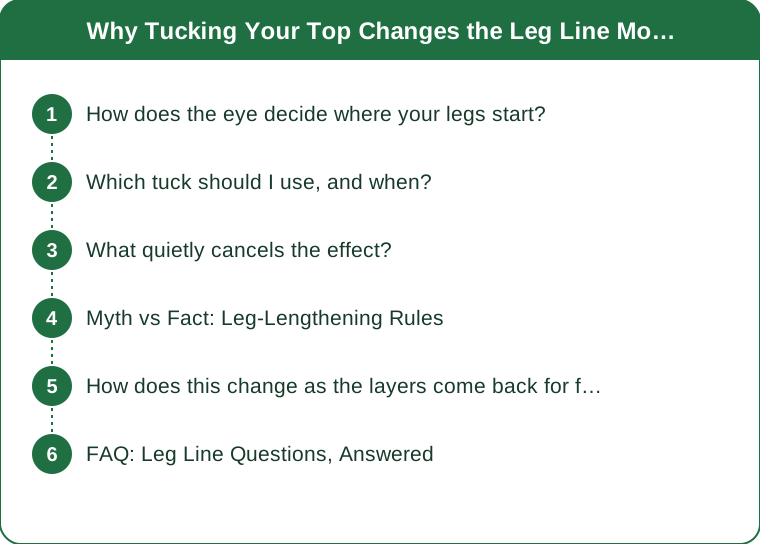
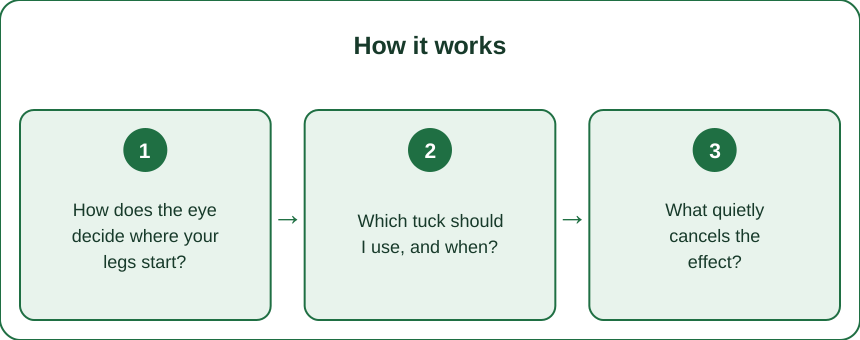
How does the eye decide where your legs start?
It uses the strongest horizontal line it can find, and it is not looking at your anatomy.
Any clear horizontal - a hemline, a waistband, a belt, a color change - functions as a divider. Your visual system reads the body as two blocks split at that line and interprets the lower block as leg.
Your actual hip joint is irrelevant to this. Nobody can see it. What they can see is where the fabric stops, and that is the line the brain uses.
So when a top ends at mid-hip, the leg block visually begins at mid-hip. Tuck the same top into a high waistband and the divider jumps up several inches - and the entire lower block, now longer, reads as leg.
Proportion, not measurement, is what registers. Nobody perceives inches; they perceive the ratio between the upper block and the lower block. A ratio that favors the lower block reads as long-legged, regardless of actual height.
This is also why the effect is so much bigger than a heel. A three-inch heel adds three inches at the very bottom of the frame, far from the dividing line. Moving the divider changes the ratio itself.
Which tuck should I use, and when?
There are four, and they do different jobs.
Full tuck. Maximum leg line, maximum formality. Best with a defined waistband and a top that is not bulky. The failure mode is bunching, which reads as sloppy and cancels the benefit entirely.
Front tuck (or half tuck). Only the front center goes in. This is the highest-value option for most people because it sets the divider high at the visual center while the sides and back skim over the hip. It works with boxy tops that a full tuck would ruin.
Side tuck. One hip only. It creates a diagonal, which reads as movement rather than as a hard line - useful when a horizontal at that height would be unflattering.
French tuck of a long piece. Tucking a long cardigan or shirt at the front while leaving the length behind. You get the raised divider and keep the vertical line of the long piece, which is the strongest combination available.
When not to tuck at all: when the waistband beneath is low. A tuck into a mid-rise pant sets the divider lower than the untucked hem would have, so it actively costs you. Check the rise before you commit.
What quietly cancels the effect?
Several things, and most people are doing at least one.
A contrasting waistband. A bright or pale waistband against dark fabric draws a hard horizontal exactly where you do not want attention. A waistband that matches the pant disappears; one that matches the top splits the leg block.
Bulk at the tuck. Fabric bunched at the waistband adds visual width right at the divider, and width at the break point shortens everything below it. Thin fabrics tuck; thick knits generally should not.
A second horizontal below the first. A belt at the waist plus a long cardigan ending at mid-thigh gives the eye two dividers, and the lower one usually wins. Pick one.
Cuffed hems. A cuff at the ankle is a horizontal at the bottom of the leg block, which visually chops off the end. The gain at the waist can be entirely spent at the ankle.
Shoes that contrast sharply with the leg. A dark pant with a bright white shoe creates a hard stop. Matching the shoe to the pant, or to your skin tone, extends the line - this is the one place footwear genuinely matters, and it is about color, not height.

Myth vs Fact: Leg-Lengthening Rules
Myth: Heels are the most effective way to look longer-legged. Fact: they add height at the bottom of the frame. Moving the waist divider changes the ratio, which is a bigger visual effect - and they stack, so doing both is better than doing either.
Myth: Only petite people need to think about this. Fact: proportion is independent of height. A tall person with a long torso benefits from exactly the same adjustment.
Myth: High-waisted means the highest rise you can find. Fact: past your natural waist, the rise starts creating a bulge and shortens the torso block awkwardly. The target is your natural waist - the narrowest point - not as high as physically possible.
Myth: A long cardigan always lengthens. Fact: it lengthens through its vertical line and shortens if its hem creates a strong horizontal at mid-thigh. Open and flowing helps; buttoned and boxy does not.
Myth: Wide-leg pants make legs look shorter. Fact: they lengthen effectively when the rise is high and the hem nearly reaches the floor. They shorten when the rise is low or the hem is too short - the width is not the variable.
How does this change as the layers come back for fall?
The seasonal shift is when most people lose the leg line without noticing.
Layers add horizontals. A jacket hem, a sweater hem, and a shirt hem are three potential dividers. Every layer you add is another place the eye can decide your legs begin, and the lowest one usually wins.
The fix is to line up the hems or space them decisively. Either stack them at nearly the same height so they read as one line, or separate them by six inches or more so they read as intentional. The bad zone is two hems two inches apart.
Cropped jackets are the strongest tool of the season. A jacket ending at or above the natural waist puts the highest horizontal exactly where you want it. This is one case where a shorter piece does more work than a longer one.
Boots reintroduce a horizontal at the calf. Tall boots in a shade close to the pant keep the line intact; contrasting ankle boots cut it. Matching your sock, pant, and boot family is the fall version of the monochrome shoe trick.
And knits need a front tuck more than tees do, because the bulk that makes a full tuck fail is exactly what makes an untucked knit sit heavy at the hip.
FAQ: Leg Line Questions, Answered
Does the front tuck work with every top?
Almost. It struggles with very thick knits and very stiff fabrics, which will not fold cleanly and create a bulge. A slightly longer top front-tucks better than a short one because there is enough length to hold the tuck.
Should the tuck be tight or loose?
Loose enough to blouse very slightly. A tight tuck emphasizes the waistband and any bulk around it; a small amount of ease reads relaxed and hides the transition.
What if I do not want to draw attention to my waist?
Use the side tuck or a French tuck under an open long layer. You still get the raised divider without a hard horizontal across the front - the vertical line of the outer piece does most of the work.
TL;DR:
- The eye reads leg length from your highest visible horizontal, not from your actual hip.
- Moving a hemline up beats adding heel height, because it changes the ratio rather than the bottom of the frame.
- The front tuck is the highest-value version for most tops and most bodies.
- Check the rise first - tucking into a mid-rise pant can set the divider lower than leaving the top out.
- Watch the second horizontal: cuffs, contrasting shoes, and mismatched layer hems undo the gain.
Try both versions in a mirror tonight with the same outfit. The difference is bigger than most people expect from a four-second decision.
Keep Reading
This article is for general informational and styling purposes only. Fit, sizing, and product availability may vary.
